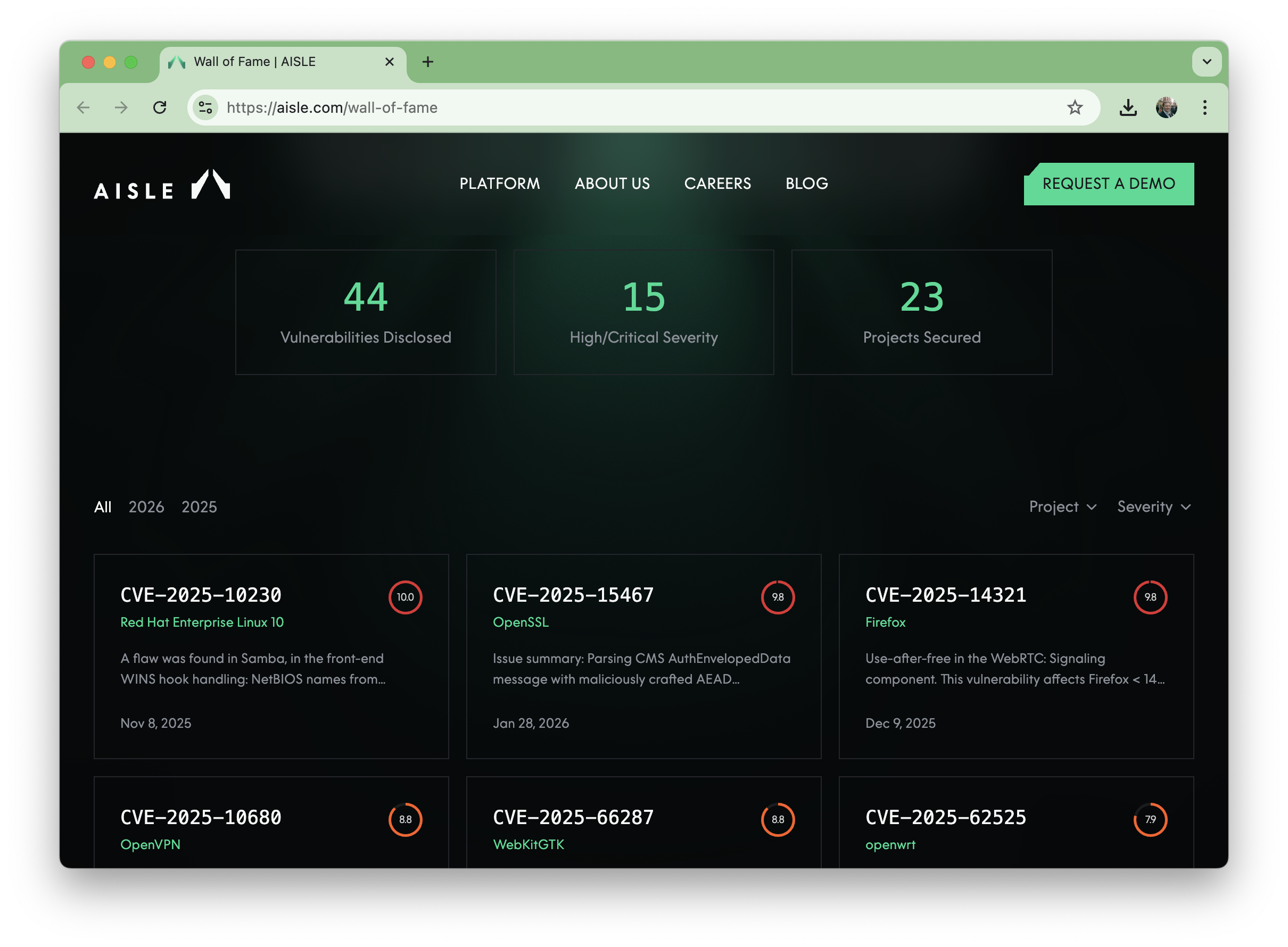
AISLE have been developing a complete AI workflow for deep cybersecurity discovery and remediation,
and if their Wall of Fame is any indicator of potential,
they may prove to be one of the most transformative companies to emerge from the AI bubble.
I must admit to being a little jaded. Where are all the AI startups delivering meaningful breakthroughs?
We were sold a vision of AI curing cancer, ending the climate crisis, and eliminating poverty.
Instead, much of the commercial narrative seems to have fixated on workforce reduction and generating a tidal wave of AI slop, along with a huge power bill.
So I wasn’t expecting to be impressed when I heard about AISLE on Security Now #1063.
But I was.
It’s 2026, and we still treat vulnerabilities as “Normal”
Since computing’s original sin of mixing code and data, security has been a cat-and-mouse game. We’ve made enormous advances in system and network security, yet we still accept one assumption as inevitable:
There is no such thing as bug-free code.
As developers, we follow secure coding practices. We run static analysis. We adopt DevSecOps pipelines. And still, vulnerabilities ship.
Our experience with AI coding tools such as Claude Code and GitHub Copilot is mixed. They fix some bugs, hallucinate others, chase red herrings, and lack a true closed-loop workflow for discovering and eliminating security flaws.
What is AISLE doing differently?
AISLE’s ambition is simple and radical: software released with zero known security vulnerabilities. Where software is assured by AISLE to be free from security vulnerabilities before it is released.
The company emerged from stealth in October 2025. In the absence of reliable cybersecurity benchmarks, they targeted live, heavily audited open-source projects including:
- OpenSSL
- curl
- Firefox
- Linux
- OpenVPN
The results have been remarkable:
- OpenSSL security patch of 2026-01-27 addressed 12 new zero-day vulnerabilities - all discovered and remediated by AISLE
- curl 8.18.0 released January 8, 2026, AISLE was responsible for 3 of the 6 CVEs
If accurate, that’s not incremental improvement. That’s industrialized vulnerability discovery and remediation.
AISLE appears to be succeeding not by building a better autocomplete engine, but by creating a full AI-driven workflow dedicated to one problem space.
Is “Zero Vulnerabilities” Realistic?
For many of us versed in the “old ways”, this sounds too good to be true! And to be sure, if software is free from security vulnerabilities, that is not the end of security issues.
Even perfect code doesn’t eliminate phishing or credential theft. Humans will always remain part of the attack surface.
But removing exploitable software flaws changes the economics of cybercrime dramatically. No zero-days means fewer catastrophic breaches.
Another AI Unicorn?
AISLE emerged from stealth backed by angel investors. No major institutional round or valuation has been disclosed yet.
But if their trajectory continues, they may become something rare: not the first AI unicorn, but possibly the first AI unicorn to actually do something significantly good for the world!
What Happens Next?
The obvious path is integration into CI/CD pipelines with a security assurance as a subscription service. One can request a demo, but I’ve not yet seen any pricing.
Longer term? Pure speculation, but I would not be surprised to see a rapid exit and acquisition. My bet would be Microsoft:
- to use internally:
- A world without Windows security patches, because there are no vulnerabilities to fix!
- to integrate with Microsoft-owned GitHub as a value-added service:
- A perfect pairing or upgrade to the existing Dependabot and Code Scanning services
- A must for enterprise clients, while ensuring the open-source supply chain that so many companies rely on is kept free from issues
If AISLE can assure software security before release, “reasonable industry practice” changes. Releasing vulnerable code may eventually be considered negligent under the law, with the old “no liability” boiler plate in license agreements challenged in court. Be prepared to defend why you are not using a service like AISLE!
References: